


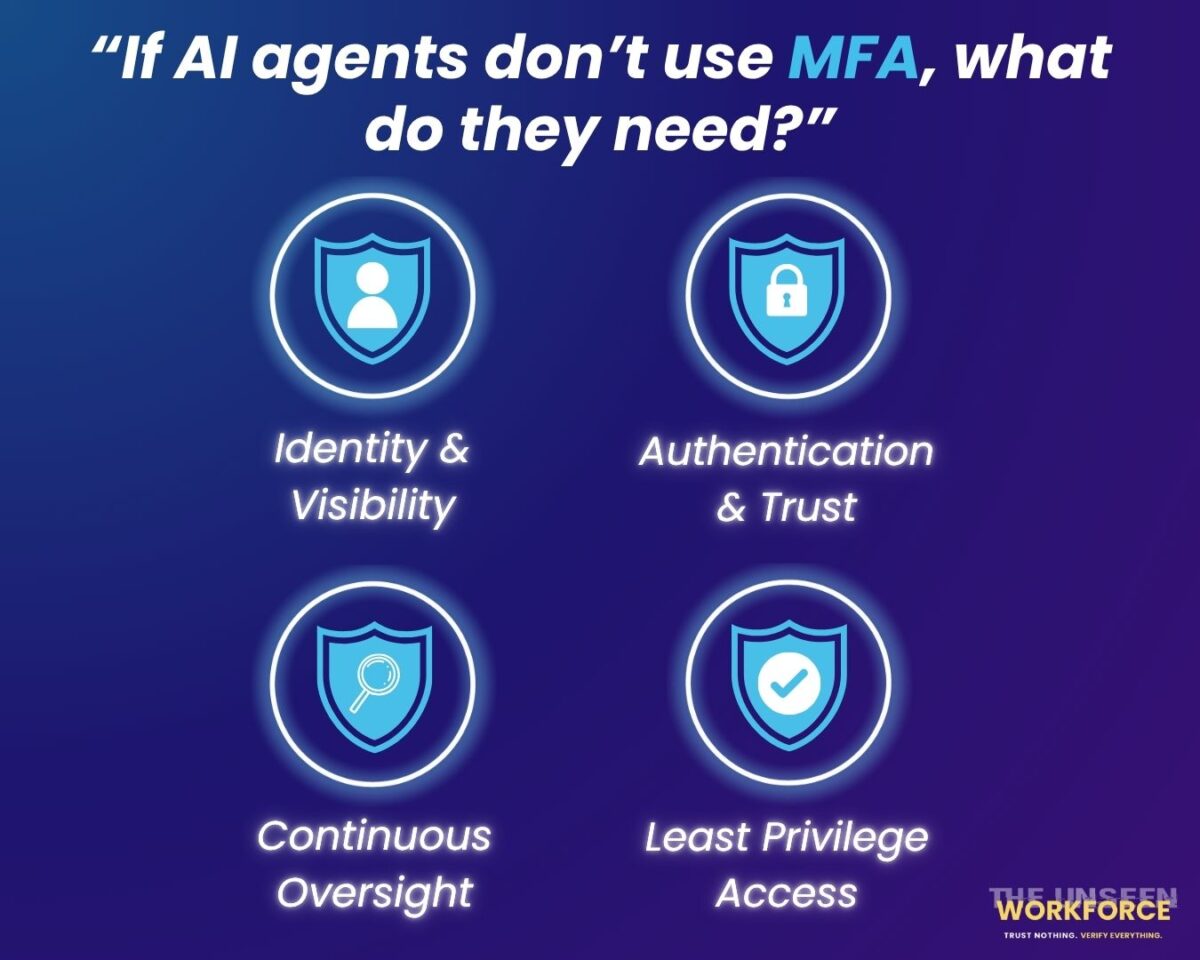
Myth: “AI Agents Don’t Need MFA”
Reality: What AI agents need instead
Instead of MFA, AI agents require four key identity security controls:
1. Identity and visibility
Before organisations can secure AI agents, they need to know where they exist. Security leaders should be able to answer:
- How many AI agents are operating in the environment?
- Who deployed them?
- What systems do they access?
- What data sources are they connected to?
- Are there unauthorised or shadow AI deployments?
2. Authentication and trust
Every AI agent needs a trusted identity. Whether that identity is established through certificates, secrets, tokens or application credentials, organisations must ensure agents can securely prove who they are before receiving access to resources.
3. Least privilege access
Many AI applications are granted excessive permissions to simplify deployment. This creates unnecessary risk. AI agents should only have access to the systems, applications and data required to perform their specific task.
4. Continuous oversight
Identity isn’t a one-time event. Organisations need ongoing visibility into:
- Agent activity
- Privileged actions
- Access changes
- Credential usage
- Emerging risks
One of the biggest challenges for security teams is shadow AI. Employees can now create or deploy AI agents with minimal oversight, often connecting them to business systems and sensitive data. Without visibility into these deployments, organisations may be exposing themselves to unnecessary risk.
What strong AI identity governance looks like
Securing AI agents requires more than policy. Organisations need visibility into what AI agents are doing, what they can access and whether they’re operating within defined boundaries.
This is where identity security platforms such as BeyondTrust can play an important role, helping security teams gain insight into AI agents across their environment, including their privileges, owners, connected systems, knowledge sources and potential shadow AI activity.
By combining visibility, least-privilege controls and secure credential management, organisations can reduce the risks associated with unmanaged machine identities while maintaining oversight of an expanding AI workforce.
As organisations continue to expand their use of AI, these capabilities become essential for maintaining control, accountability and trust in machine identities.
The bottom line
AI agents may not need MFA, but they do need identity security. As the unseen workforce grows, trust can no longer be assumed. It must be continuously verified.