


Artificial Intelligence (AI) is unlocking new possibilities across every sector, from advancing medical research to transforming everyday productivity. As organisations move quickly to realise AI’s potential, managing the security risks associated with its adoption is becoming just as important as the opportunities it creates.
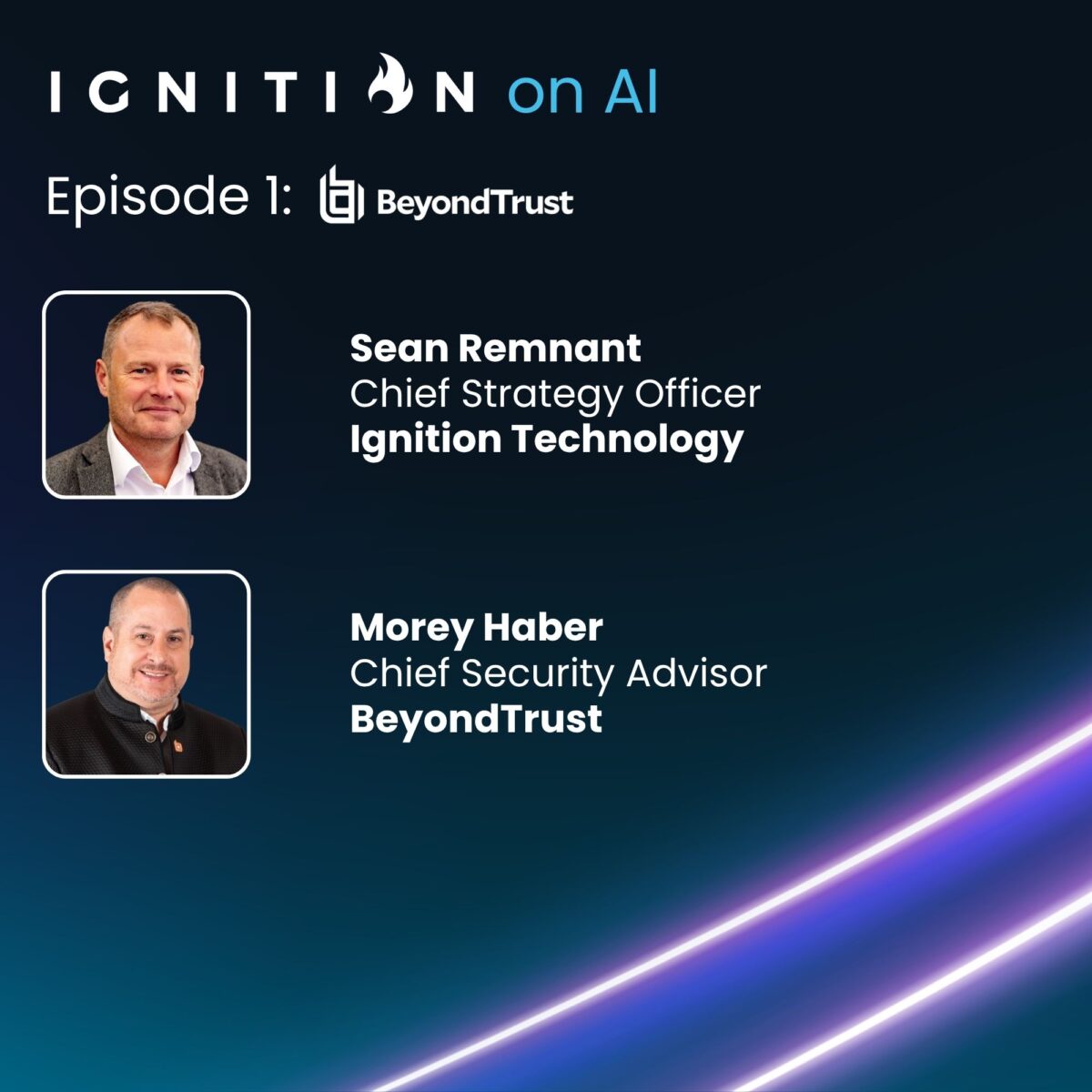
As part of the Unseen Workforce campaign, Ignition Technology is launching ‘Ignition on AI’. a new monthly video podcast series designed to help partners, and customers make sense of the rapidly evolving AI landscape. Hosted by Ignition Technology’s Chief Strategy Officer, Sean Remnant, each episode will feature a leading voice from across the cybersecurity and technology industry, providing expert perspectives on the trends, opportunities and risks any growing organisation should understand and act upon.
In our debut episode, Sean is joined by Morey Haber, Chief Security Advisor at BeyondTrust, to discuss the rise of agentic AI, where identity security fits into the conversation, and the practical steps organisations can take to stay secure, compliant and in control as AI adoption accelerates.
What is agentic AI?
A key focus of the discussion throughout the episode was understanding what agentic AI is and why it’s generating so much attention across the industry.
According to Morey, while many organisations are becoming familiar with AI assistants and copilots, agentic AI represents the next stage in the AI evolution. Unlike Agent AI designed to perform a specific task, agentic AI is an ecosystem of multiple agents, data sources, connectors and workflows working together autonomously to achieve a desired outcome.
An individual agent may retrieve information from a specific system, while agentic AI is the full system that coordinates multiple agents to complete a broader business process from start to finish.
In the episode, Morey uses the example of financial forecasting to illustrate how an agentic system could pull information from multiple sources, including internal business systems, news feeds and external datasets. It can then analyse that information and deliver recommendations or outcomes. While this creates significant opportunities for productivity and automation, it also introduces new challenges around access, governance and control of systems and data.
The challenge is that these machine identities are given access to applications, data and business systems to perform their role. As organisations deploy more agents, maintaining visibility over what they can access, what actions they are taking and whether permissions are being appropriately governed becomes increasingly difficult. Without the right controls in place, AI agents can create security and compliance risks at scale.
Morey emphasised that organisations need to stop viewing agents as digital employees that can simply be managed like people. Unlike human users, agentic systems are dynamic, can make decisions independently and operate at machine speed. As a result, traditional approaches to access management and security often aren’t enough.
Staying in control of agentic AI
When discussing how organisations can maintain control over this growing population of machine and AI identities, Morey explained how BeyondTrust’s approach is evolving alongside the market. As identity has become the primary attack surface for cybercriminals, BeyondTrust’s focus has expanded towards what Morey describes as ‘privilege-centric identity security’.
Attackers increasingly prefer to log in rather than hack in. As organisations deploy more AI agents and machine identities, every new identity represents a potential risk if permissions aren’t properly governed.
Morey explains BeyondTrust’s role is helping organisations understand and secure those identities through a framework built around Visibility, Intelligence and Protection (VIP). This starts with helping organisations discover where agents are operating, understand what permissions they have and identify potential risks. From there, controls such as least privilege, just-in-time access and identity threat detection can be applied to reduce the likelihood of misuse or compromise.
Explore the full conversation
Watch the full episode of Ignition on AI, to better understand how AI is reshaping identity security, what organisations need to understand about the rise of autonomous agents, and the practical steps businesses can take to stay secure, compliant and in control.
Subscribe to the Ignition Technology YouTube channel to catch future episodes of Ignition on AI.